Monday, 12 June 2017

NOW & FUTURE: A sneak peek in the Aerospace industry

Today, the Aerospace industry is on the threshold of entering a new era, where it will presume bigger responsibility in making the nation self-reliant in Defence Production. Flying cars, hybrid vehicles, massive jets, sleek new fighters, and Mars-bound rockets. These are the kinds of things we consider when we think of our latest heights in the endless evolution of human flight. But there is more to this, the sector has a lot more to offer…. more than what we can imagine!!! Let’s take a sneak peek into this sector of Aerospace.

The outlook for Aerospace industry is clouded by many uncertainties like constrained military budgets, new and changing requirements, technology advances, and competition from non-traditional rivals. 
The Software upliftment.
Software is handling a greater percentage of the jobs done on an aircraft. Increased communication with ground control will soon allow for more efficient landings. Currently planes approaching an airport do so in a stair-step process. This allows the control tower to maintain safety at each stage. But when the exact position of each plane is known, the approach can be continuous. The smoothness of the descent will mean every flight will be shorter by two or so minutes and save about 100 gallons of gas. That time may be minuscule for the passenger, perhaps, but worldwide, the savings are enormous.
Communication.
Planes usually need communication to provide information on their current location. This is very important especially for those working in defence programs. Communication allows pilots to tell the distance between them and other pilots to prevent them from crashing into each other. But, communication can only go so far. A recent research program allows a set of drones to be able to communicate with each other’s distance without even talking. These drones were simple AI machines that could tell the distance between each other. This is truly helpful in terms of flying and coordination especially for those pilots with surveillance and targeting assignments.
Growth
Major challenges to international growth include political risks such as export-control regulations and offset requirements, technology-transfer requirements, and intellectual-property issues. Many of these challenges may have reoccupied leaders in 2017. But today they are less concerned about their companies’ inherent abilities to make sales in international markets and more about the political landscapes of the customer nations. So, we may now look forward to a better growth this year.
Education
Aerospace is the third most popular field for engineering students. With over 38,000 new aerospace engineering jobs that opened last year, 4,000 of them were taken by students! That’s a huge number. The aerospace profession has expanded form hardware-based science, technology, and engineering, to systems, and even systems of systems-based engineering. At a very high level that trend has become even more important. And thus, this year we expect, a lot of young professional to take up Aeronautics as a profession!
Data Handling
Surveillance vehicles get a lot of attention for political, military, and techie reasons. But in the field of aerospace engineering, their development and employment is a much smaller challenge. It is likely to be found with millions of investments that the government recently marked for “big data.” This data brings us to a conclusion that there will be a lot of data which would help the defence to be upgraded.
In a nutshell, we can look forward towards a positive and proportionate growth in this sector of Aeronautics and defence. And talking about this sector and technologies that drives it, Moschip is the name that comes in our mind. It has not only successfully been a pioneer in the field of Semiconductors Design Services but has also put its footprint in the field of IoT, Cloud and Connected Devices domain, with respect to this sector of Aeronautics and defence. Driven by a positive outlook, Moschip is moving to more flexible, agile models.

https://moschip.com/blog/company-newsnow-future-a-sneak-peek-in-the-aerospace-industry/

Moschip grabs the Best Electronic System Design Company – Established Indian Company

Mentor Graphic corporation (NASDAQ:MENT), a leader in electronic hardware and software design solution along with Silicon India, announces the 2016 Leadership Awards for Embedded / VLSI industry.

The Silicon India Award is one of its kind, felicitating the best of VLSI/Embedded industry, since 2010.This is the 6th edition, where in the best of VLSI/Embedded industry were honoured with a great show.
Among few others best firms, Moschip grabbed the award for the BEST ELECTRONIC SYSTEM DESIGN – ESTABLISHED INDIAN COMPANY.   Moschip is one of the pioneers in publicly listed semiconductor design and service company. It has an extensive experience in arrays of industries like Aerospace and defence, Consumer electronics, IoT to name a few.
This Award Would Not Only Motivate But Also Give Inspiration And New Spirit For Innovation And A Strong Entrepreneurial Drive.”- Speaks Mr. Ram Reddy, CEO & Chairman, Moschip.
Moschip’s extensive ASIC design experiences ranges from architecture to netlist. With its mission to constantly exceed the client’s expectation, it has a long way to go!

https://moschip.com/blog/company-news/moschip-grabs-the-best-electronic-system-design-company-established-indian-company/

The First Chapter of AeSI, Aerospace Luminary Lecture series of Hyderabad


Hyderabad: Aeronautical Society of India in association with MosChip, Organised the 1st AeSI Aerospace Luminary Lecture series, Hyderabad Chapter at Taj Deccan.  Attended by 300 Plus guest, it has been one of the major event that the city witnessed on Sunday evening. Air Marshal SB Deo, vice chief of air staff & Indranil Manna, director of Indian Institute of Technology, Kanpur were the key note speaker of the evening.
“The Indigenously Designed Developed And Manufactured (IDDM) Category Will Be The Ministry Of Defence‘s First Priority When It Comes To Procurement Of Weapons And Spare Parts, Said Air Marshal SB Deo, Vice Chief Of Air Staff.”
Speaking at the Aerospace Luminary Lecture series of the Hyderabad chapter of the Aeronautical Society of India here on Sunday, Mr Deo said: “The private sector had once challenged to obliterate public defence organisations like DRDO. Today we are around and they are not,” he said. Speaking about leadership at DRDO of stalwarts in the sector, he said passion is crucial. “Working for profit cannot take us far. Working with passion can,” he said.
The meeting was presided by G. Sateesh Reddy, Scientific Advisor to Defence Minister, who lauded the work of the society while asking it to continue contributions even as he outlined the activities lined up for the society this year.
“Weapon technology should be desi”- Air Marshal SB Deo
Deputy Chief of Air Staff, Air Marshal Sirish Baban Deo and IIT Kanpur Director Indranil Manna delivered lectures on Make In India programmes in the aerospace sector and progresses in technology for the sector. Prof. Manna, an expert in materials sciences, said the perspective of the world about India should change. “We are thought of as a trading country when we should be a making country,” he said. He added that pursuit of the aerospace sector, among other things, is to make materials like aluminium better for the industry.
As part of the Lecture Series, Mr. Ramachandra Reddy, Chairman & CEO of MosChip Semiconductor Technology Pvt Ltd., gave a presentation on the Semiconductor Industry, journey & success story of MosChip and their contribution to Indian Defense Labs. Moschip has been a pioneer in the field of Semiconductors Design Services, with constant innovations, technological advancements and vision oriented leadership. Moschip has now, put its footprint in the field of IoT, Cloud and Connected Devices domain, said Mr. Ramachandra Reddy.

https://moschip.com/blog/company-news/the-first-chapter-of-aesi-aerospace-luminary-lecture-series-of-hyderabad/

Friday, 9 June 2017

The Happy Marriage of DevOps and IoT - Moschip

The Happy Marriage of DevOps and IoT


Service revenues rooted in micro-controller-based IoT are expected to reach a whopping $7.3 trillion by the year 2017, according to a recent IDC report, with the radical new paradigm shift of DevOps leading to the perfect storm of IoT adoption.
About two years ago, we started to see a groundswell, The Internet of Things (IoT).  IoT promised that businesses would see trillions of dollars in new value as everything on the planet became connected. This value was going to be driven by increased efficiencies, better customer engagement, and new business models.
A few years further backwards, the hottest term in IT was DevOps. Based on Agile and Lean principles, DevOps helped in enhanced speed and quality of IT services delivery. Enabling a continuous delivery approach, it ensured that the software is thoroughly tested, validated and bugs identified at the earliest. Since then, DevOps has been ensuring the alignment of goals of all functions of the enterprise. The outcome is a seamless process that works efficiently and without glitches. DevOps has already gained a foothold at the enterprise level, as it has been critical to make the best use of cloud computing, big data, and, now, the Internet of Things (IoT).
DevOps makes possible the deployment of software across several platforms simultaneously. Organizations that embrace DevOps in IoT and formalize it through integrated, cross functional teams are likely to have a decided advantage over those that do not.
DevOps in IoT also enable constant update of devices and features, and faster release cycles of connected systems. The ability to constantly deliver new software updates makes it possible to sell services that generate continuous revenues, rather than simply the one-time sale of the underlying product.
Most importantly, IoT is something that comes into play with automated security testing (continuous testing), integration testing (continuous integration), and, finally, deployment (continuous deployment). This is where DevOps methodology can play a vital role.
When the IoT application is tested, a DevOps system needs to consider security around the information coming from sensors.  These are points-of-entry that are easily compromised, such as somebody hacking into your thermostat and sending misleading data.  DevOps security testing tools need to regress through the IoT application to ensure that exposure is minimized.
The case for evolving DevOps, from enterprise systems to IoT edge devices is compelling. But we must agree, change is rarely easy, and instituting DevOps in IoT is no exception. Bringing about a cultural and organizational change, to build necessary processes and systems is rather difficult. Also, IoT systems can be very large, unique, and complex and may require robust hardware platforms. This increases cost. To add to this, IoT solutions have very high demands for reliability, quality, security, and safety. This can be both risky and expensive at the same time.
While we’re still playing around with DevOps and IoT, it’s clear that the connections can be made, and we can indeed benefit from the marriage of IoT and DevOps.  The DevOps concept has been proven at the enterprise level. It is now evolving toward gateways and edge devices, to meet the unique challenges of developing and managing IoT systems.

Fuel it Up! Automotive to Fuel Power Semiconductor Growth - Moschip

The global market for power semiconductors used in cars and light passenger vehicles will grow by more in $3 billion USD in the next six years,” according to new analysis released today by IHS Markit, a world leader in critical information, analytics and solutions.
End to end markets that stimulate overall demand for semiconductors are expanding. As silicon-led technology exerts, its influence on many different aspects of life. The automotive sector promises to be a particularly dynamic driver of growth for the semiconductor industry. Not only is the semiconductor content of cars growing rapidly as they rely on greater intelligence, connectivity and sophisticated electronics, but the nature of the automotive industry model is also shifting in new directions.
The Latest Report Released By IHS Markit Predicts That The Global Market For Power Semiconductors Used In Cars And Light Passenger Vehicles Is Estimated To Grow By More Than $3 Billion USD In The Next Six Years. 
Contributing to the rise of power semiconductors, the automotive industry’s mission is to offer self-driving, ‘green’ and connected cars, by the next decade.
The key drivers behind the robust growth include the electrification of vehicles, as well as self-driving, green and connected cars, according to the “Power Semiconductors in Automotive – 2017” report.
According to IHS Markit, intermediate safety milestones such as automatic emergency braking (AEB) and platooning are necessary to realize a road system that will accommodate self-driving cars. Other factors in the trend toward more power semiconductors include the need for more fuel-efficient systems, reflected by increasingly electrifying auxiliary units such, a higher proportion of electric vehicles, and more electronic content per vehicle as required for improved vehicle emission levels.
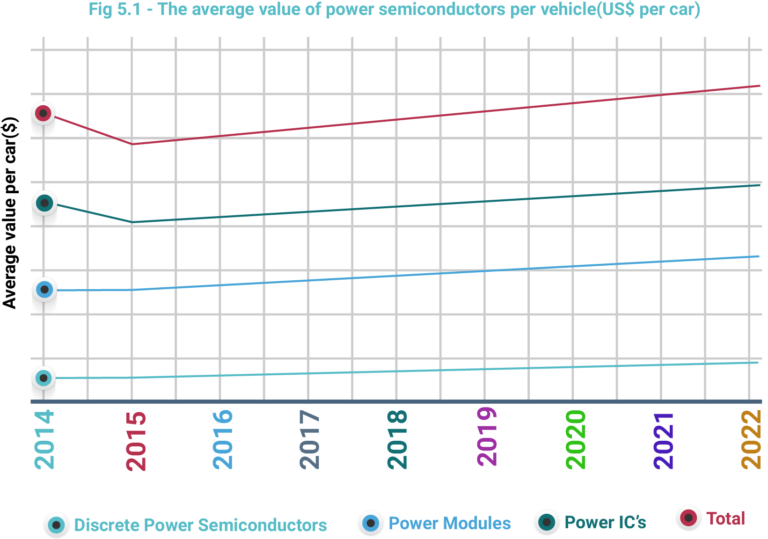
Fuel-it-up-graph-768x539

The Chart Shows An Estimated Average Value Of Power Semiconductors Per Car. It Is The Estimated Total Market For Discrete Power Semiconductors, Power Modules And Power ICs Each Year Divided By The Total Number Of Light Vehicles Produced In Each Year.
It is anticipated that the growth in sales of hybrid and electric vehicles in the next few years will spur power semiconductor sales to climb by CAGR 9.6% from 2015 to 2022 across all vehicles, taking Powertrain’s market share up to 54% of the total market, the report says. Discrete IGBT power transistors account for most of Powertrain power semiconductor revenue, but increased integration of discretes into modules will cause IGBT power module sales to increase at a much faster rate.
Cars and chips. Less than a decade ago this would not have been the most obvious of pairings, but this will be a key driver of our industry today. From self-parking cars to anticipatory braking, semiconductors have been important to automotive innovations in the past decade. As a result, automotive semiconductor revenue is growing at nearly twice the rate of the overall semiconductor market.
MosChip Has Been Leading The Semiconductor Market With Constant Innovation To Drive Automotive Industry. With An Approach To Adopt The ‘Green-Car’ Concept, MosChip Contributes To The Environment, Safety And Comfort.

IESA expands Footprint; Launches Hyderabad Chapter - Moschip

IESA expands Footprint; Launches Hyderabad Chapter

Aims to strengthen ties with the local industry and government to make Hyderabad an ESDM and Aerospace and Defense hub
Hyderabad, 16th February, 2017: IESA, India Electronics and Semiconductor Association, today announced the launch of their Hyderabad Chapter. The key objectives of setting up an office in Hyderabad is to widen the eco-system, acquire new members and strengthen the supply chain in the region. This move will boost the electronics, hardware and semiconductor startups and firms in the state with the required support and information. There will also be a large thrust on the Aerospace & Defense manufacturing too.
Spearheading and strengthening ties with the local industry, MosChip Semiconductor has joined hands with IESA. Speaking at the launch of the IESA Hyderabad chapter, Ram Reddy, CEO & Chairman, MosChip , said “We are delighted to be a member company of IESA Hyderabad. We strongly believe that this collaboration will be an impetus to start-ups and engineering/ research students to promote the country’s top design engineers and buyers with the best degree of technical knowhow and help bring the Government and ecosystem together on the same platform.”
IESA Launches Hyderabad Chapter at MosChip
Excited with this announcement, K. Krishna Moorthy, Chairman, IESA said, “This is a proud moment for us as we have now expanded our presence across the major technology hubs of the nation. With this launch, we now have an even more strengthened support to bring India into the global radar for manufacturing innovation.”
Commenting on this move, Mr. M.N. Vidyashankar, President, IESA added, “We strongly believe that this expansion will fast-forward our operations and enable us to achieve the common goal of giving a boost to design-led-manufacturing.”

Global semiconductor industry to see an upwards growth - Moschip

According to Gartner, Worldwide semiconductor revenue is forecast to total $364.1 billion in 2017, an increase of 7.2 percent from 2016. It is a huge leap of 7.2% compared to 2016, and is said to be a surprise for the industry as the growth for 2016 was just 1.5%.
The semiconductor industry is rapidly becoming an innovation battleground. The contract manufacturing trend has pumped in millions of dollars into emerging and developing countries such as China, India, and Brazil while offering cost savings to electronics and technology companies. The growing aerospace and defense, healthcare and medical devices, telecommunications, and consumer electronics sectors are all embracing miniaturization, making it imperative for the semiconductor and electronics industry to respond actively.
However, compromising performance at the expense of cost is not an option in a highly competitive semiconductor and electronics industry. This has compelled companies to invest heavily in research and development. As the need for memory chips and processors to solve specific issues becomes pressing, larger companies are now turning their attention toward niche markets, leading to an uptick in the number of mergers and acquisitions in the semiconductor and electronics industry. The future of this industry will thus be dictated by changing computing and communications needs.

Key findings:

  1. Considering that the global economic outlook seems quite fragile, the current market scenario remains mixed for the coming few years.
  2. Semiconductor industry will see significant growth in the automotive and industrial markets.
  3. The production of the number of vehicles in Brazil, Russia, India and China will experience a promising increase, driving the automotive market followed by an increase in the average semiconductor content per vehicle.
  4. The growth of the industrial sector is fuelled by the expansion of high-speed rail transportation. Rise in the demand of energy in the industrial sector will also inevitably lead towards the need of renewable energy resources.
  5. Continued strong market positions by the data processing application market, driven by accelerating tablet sales, and the communications market by the sales of smartphones. Consumer electronics also benefit from a growth in units sold, particularly in digital set-top boxes.
  6. China will retain its dominant position with an increase in its market share of global semiconductor sales to almost half of the worldwide market.
  7. The global production capacity for semiconductors will increase to meet the global demand.
  8. Overall production capacity is sustaining progress toward smaller feature sizes and larger wafer diameters.
  9. Positive returns from the Operating profitability, except in the memory and back-end processes subsectors, which face strong competition and cycles of overcapacity.
  10. Working capital has been re-established to normal levels.
graph
Overall, the mixed growth seen in 2016 will turn into a broad and more consistent growth in 2017. Areas to watch for in 2017 are the industrial, automotive and storage markets, which are growing quickly but represent a smaller portion of the overall market. Additionally, the slow-growth outlook for traditional applications such as smartphones and PCs, highlights the importance of semiconductor.

https://moschip.com/blog/semiconductor/global-semicondutor-industry-to-see-an-upward-growth